- Sports
- Sports
Padel Rules Explained: Scoring, Serving and the Walls
Padel borrows its scoring from tennis and its rebounds from squash. The serve, the walls, the faults and a quick comparison with pickleball, so your first match makes sense.
· 4 min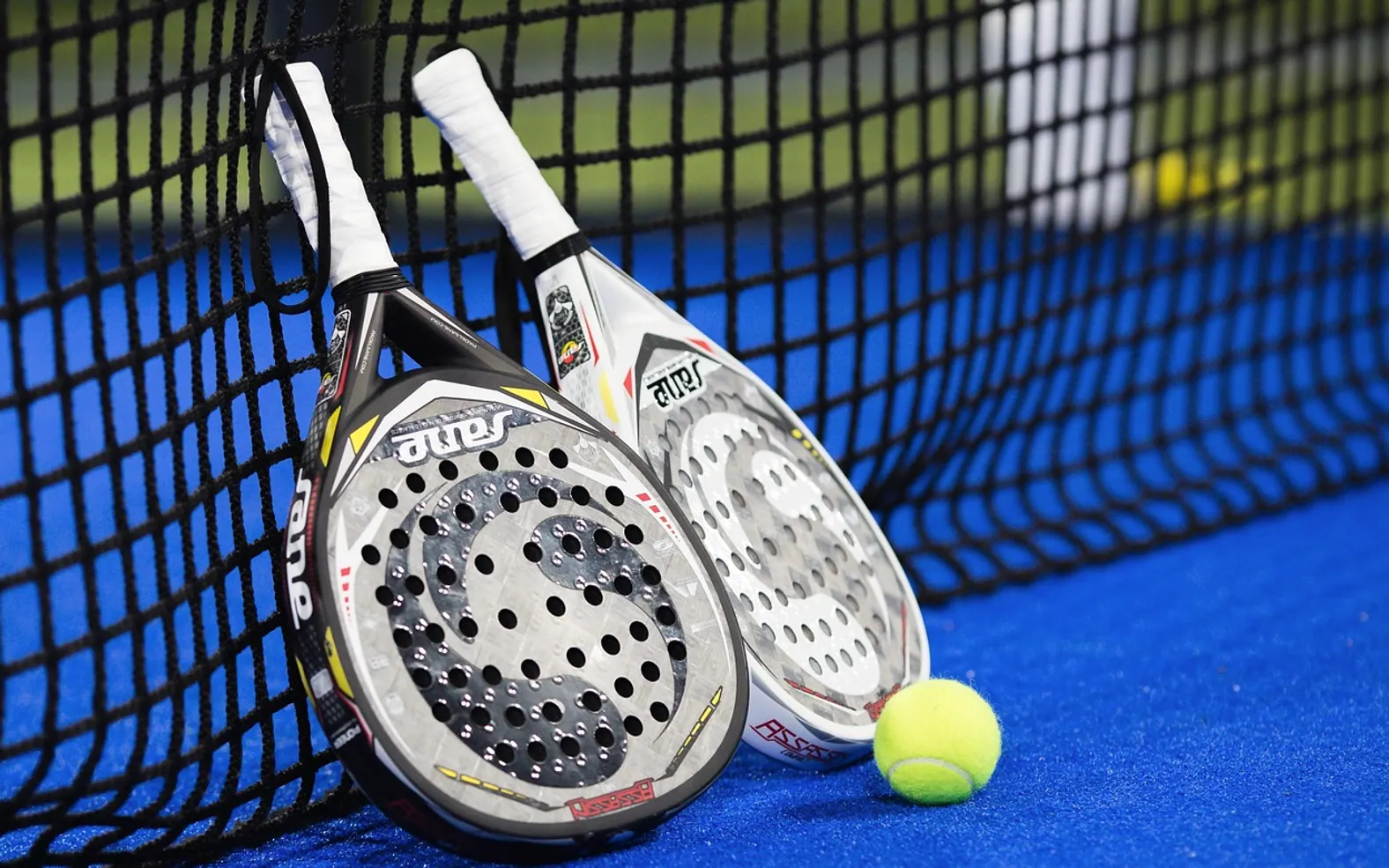
Padel is a racket sport usually played in pairs on an enclosed court a little smaller than a tennis court, with glass walls at each end and wire mesh along parts of the sides. The scoring is the same as tennis, the serve is underhand, and the walls are part of play: after the ball bounces on your side of the court, you can let it rebound off the glass and still return it. That mix of tennis and squash is what makes it easy to pick up and hard to put down.
The court and the kit
A standard court measures 20 by 10 metres, split by a net. Each half has a service line and a centre line dividing it into two service boxes. The back walls are glass or solid panels, and the side walls combine glass sections with metal mesh.
Rackets are solid, without strings, usually perforated with small holes and fitted with a wrist strap you should always wear. Balls look like tennis balls but are slightly less lively. Shoes with a grip suited to the court surface, often artificial grass with sand, help you change direction safely.
How scoring works
If you know tennis scoring, you already know padel scoring.
- Points: 15, 30, 40, game. At 40–40 (deuce), a side needs two points in a row to win the game, unless the match uses a deciding "golden point" at deuce, which some clubs and events prefer.
- Games: the first pair to six games, with a two-game lead, wins the set.
- Tie-break: at six games all, a tie-break is usually played to seven points, again with a two-point margin.
- Match: most matches are best of three sets.
The serve
- Stand behind the service line, with neither foot touching it.
- Bounce the ball once on the ground behind the line.
- Strike it underhand, with the ball at or below waist height at contact.
- Send it diagonally across the net into the opposite service box.
- The ball must bounce inside that box. If it then rebounds off the glass, the serve is good and play continues.
You get two attempts, as in tennis. A serve that lands outside the box, or bounces in the box and then hits the metal mesh, is a fault. A serve that clips the net and lands in the correct box is replayed, unless it hits the mesh afterwards. Serving starts from the right-hand side and alternates with each point.
Playing off the walls
This is the part that confuses newcomers, and it becomes second nature quickly.
- The ball must bounce on the ground on your opponents' side before touching any of their walls or mesh. If your shot hits their wall directly, you lose the point.
- After that first bounce, the ball may hit the walls on that side as often as it likes, and the receiving pair can still play it, as long as it has not bounced on the ground a second time.
- You may hit the ball into the walls on your own side so that it rebounds over the net, a handy escape when you are trapped deep in a corner.
- Volleys are allowed everywhere except on the return of serve, which must bounce first.
Common ways to lose a point
- The ball bounces twice on your side before you return it.
- Your shot hits the net and stays on your side, or lands outside the court.
- The ball touches you or your partner.
- You or your racket touch the net while the ball is in play.
- Your return hits the opponents' wall or mesh before bouncing on their ground.
- You hit the ball twice, or both partners hit it on the same shot.
Padel vs pickleball
Both are friendly, quick-to-learn racket sports, and they are often compared. The main differences:
| Padel | Pickleball | |
|---|---|---|
| Court | Enclosed by glass walls and mesh | Open court, no walls in play |
| Racket | Solid, perforated, with a foam core | Flat paddle with a smooth face |
| Ball | Pressurised felt ball | Lightweight plastic ball with holes |
| Scoring | Tennis-style games and sets | Games commonly played to 11, win by 2 |
| Special rules | Rebounds off the walls stay in play | A no-volley zone next to the net and a two-bounce rule at the start of each rally |
Padel rewards patience and positioning, because the walls give you a second chance at many balls. Pickleball rewards soft touch at the net. Try both if you can; plenty of players enjoy each for different reasons.
Tips for your first games
- Let the ball come off the back glass rather than lunging at it early. It usually gives you more time than you think.
- Move together with your partner, side by side, either both at the net or both at the back.
- Aim lobs high over the players at the net; it is one of the most useful shots in the game.
- Warm up first, especially shoulders and calves, and stop if anything hurts.
Quick answers
Can you play padel as singles?
Yes, on narrower singles courts, but most courts and most games are set up for doubles.
Where can I play while travelling?
Some hotels, resorts and holiday parks now have courts on site. If that matters to you, add it to your checklist when choosing a hotel you will actually enjoy.
What other sports are easy to start with friends?
Try a round of disc golf in the park, or for something completely different, a session in a vertical wind tunnel, described in our guide to your first indoor skydiving flight.
Hand-picked reads
 BusinessSmart, Clean, and Ready: How Container Service in Germany Keeps Cities Moving2 min
 HealthWatching TV Before Bed: Is It Really Bad for Sleep?4 min
 StreamingHow IPTV Makes Multilingual Entertainment Easier in Switzerland2 min
 BeautyThe Rise of Refillable Vapes: A Smarter Choice for Modern Vapers3 min