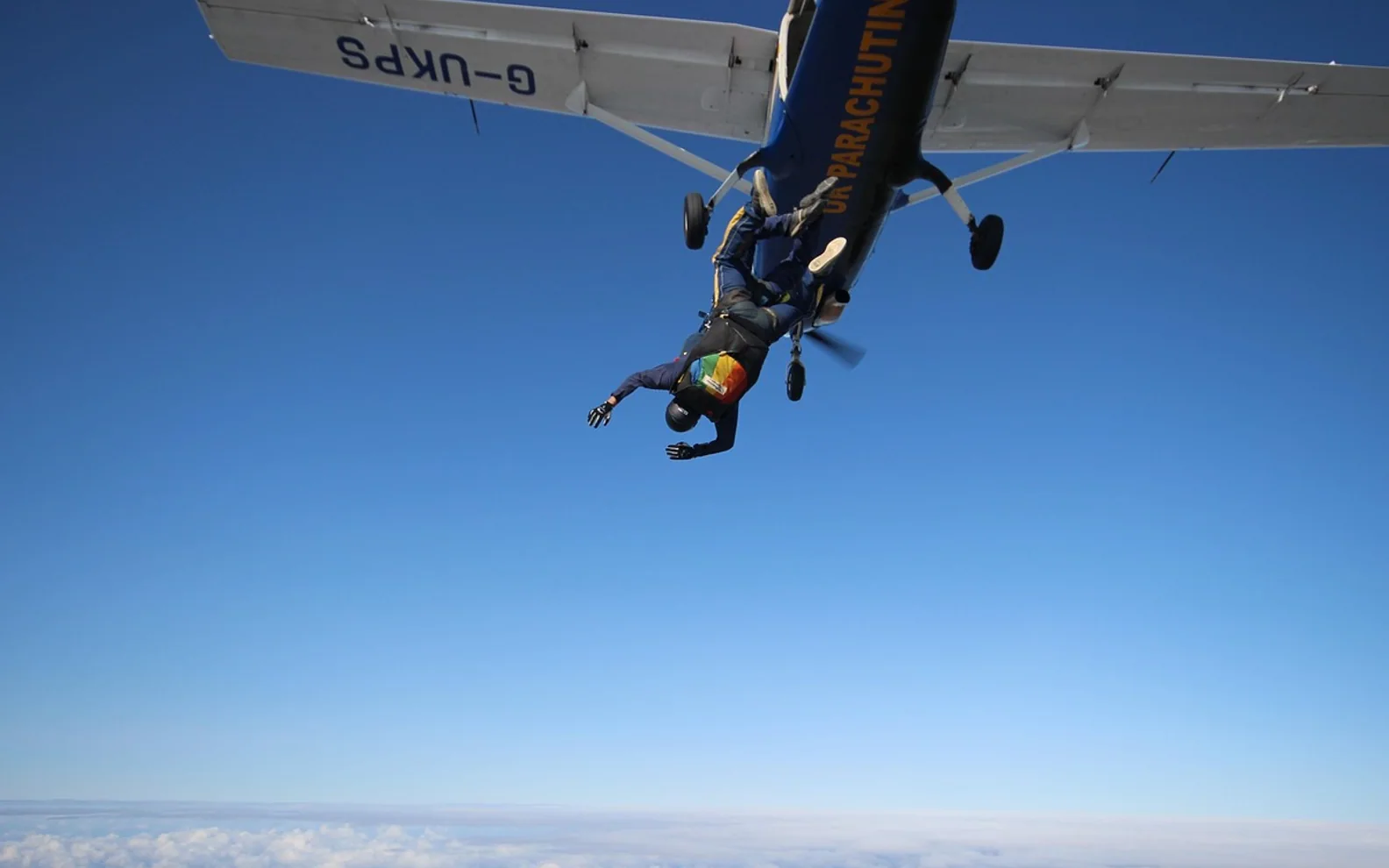
Indoor skydiving means floating on a column of fast-moving air inside a vertical wind tunnel. A first session usually starts with a short classroom briefing, then a change into a flight suit, helmet, goggles and earplugs, followed by brief flights in the tunnel with an instructor right beside you. There is no aircraft, no parachute and no height involved, which is why it appeals to people who are curious about freefall but not ready to jump out of a plane.
How a vertical wind tunnel works
Large fans move air upwards through a glass chamber. When the air is fast enough, a person lying belly-down on it is held up, much as a skydiver is held up by the air rushing past during freefall. Staff control the wind speed from a desk outside the chamber and adjust it to each flyer's size and skill. A net or mesh floor sits below the flying area, and padded walls surround it.
What happens at a first session
- Check-in and paperwork. Expect a waiver and questions about health, height and weight. Arrive early; briefings tend to start on time.
- The briefing. An instructor explains the body position, how to enter and leave the tunnel, and the hand signals used inside, where the noise of the air makes talking impossible.
- Getting kitted out. You are given a flight suit, a helmet, goggles and earplugs. Remove jewellery and empty your pockets; anything loose can be picked up by the air.
- The flights. First-timers usually fly in short rounds rather than one long block. The instructor stays in the chamber, holding and guiding you, and corrects your position with simple signals.
- Debrief. Many centres show you a video or photos afterwards and explain what to work on next time.
Flight time often feels short on paper, but holding a steady position in strong airflow is surprisingly tiring. Most people are glad of the rest between rounds.
The body position in plain words
The basic shape is called the box or arch. Think of lying on your stomach with your hips pushed slightly forward, chin up, arms bent at shoulder height and legs a little apart with the knees slightly bent. The secret is relaxation: tense muscles make you rock and spin, while loose shoulders and a steady arch let the air do the work.
The hand signals you will see
- Chin up: lift your head and look forward, towards the instructor or the window.
- Legs: two fingers, held straight or bent, showing whether to stretch or tuck your legs.
- Relax: a loose, shaking hand.
- Arch: a curved hand asking you to push your hips forward into the air.
Centres use slightly different versions, so pay attention to the ones shown in your briefing.
Limits and health questions to check
Every facility sets its own rules, so look at their requirements before booking and ask if anything is unclear. Things they commonly ask about include:
- Weight and height limits, which vary with tunnel size and wind speed.
- A history of shoulder dislocations, back or neck problems, or recent surgery.
- Heart conditions and pregnancy.
- Minimum ages and whether a parent must sign for children.
If you have any medical condition or injury, ask your doctor whether flying is suitable for you, and tell the instructors before you go in.
Indoor skydiving vs a real jump
| Wind tunnel | Tandem skydive | |
|---|---|---|
| Where | Indoors, at ground level | From an aircraft at altitude |
| Weather | Not a factor | Can delay or cancel the day |
| Freefall feeling | Belly-down flying in strong wind | Wind plus the full view and the exit from the plane |
| Parachute | None | Opened by the tandem instructor |
| Learning | Body position can be practised in short, repeatable rounds | One freefall per jump |
Many skydivers train body flight in tunnels because the air is predictable and the sessions can be repeated. Licensed jumpers in a tunnel usually wear their own kit, and a well-fitting helmet matters there just as it does in the sky; our guide to choosing a skydiving helmet covers open-face and full-face styles and how a good fit should feel.
Tips for first-timers
- Wear comfortable clothes and lace-up trainers that will not come off.
- Tie long hair back and leave valuables in a locker.
- Eat lightly beforehand; a heavy meal and strong airflow are not a good mix.
- Breathe. People often hold their breath on their first entry without realising.
- Watch others fly before your turn to see what a stable position looks like.
Quick questions
Is indoor skydiving scary?
Most people feel nervous at the door and then surprised by how controlled it is. You are never more than a short distance above the net, and an instructor is with you throughout.
Can you fly in glasses?
Many centres provide goggles that fit over glasses, but ask in advance. Some flyers prefer contact lenses.
What other sports give a similar buzz?
If you want something more regular and social, a racket sport such as padel or an easy-going round of disc golf brings plenty of fun without a wind tunnel.
Hand-picked reads
 BusinessSmart, Clean, and Ready: How Container Service in Germany Keeps Cities Moving2 min
 HealthWatching TV Before Bed: Is It Really Bad for Sleep?4 min
 StreamingHow IPTV Makes Multilingual Entertainment Easier in Switzerland2 min
 BeautyThe Rise of Refillable Vapes: A Smarter Choice for Modern Vapers3 min