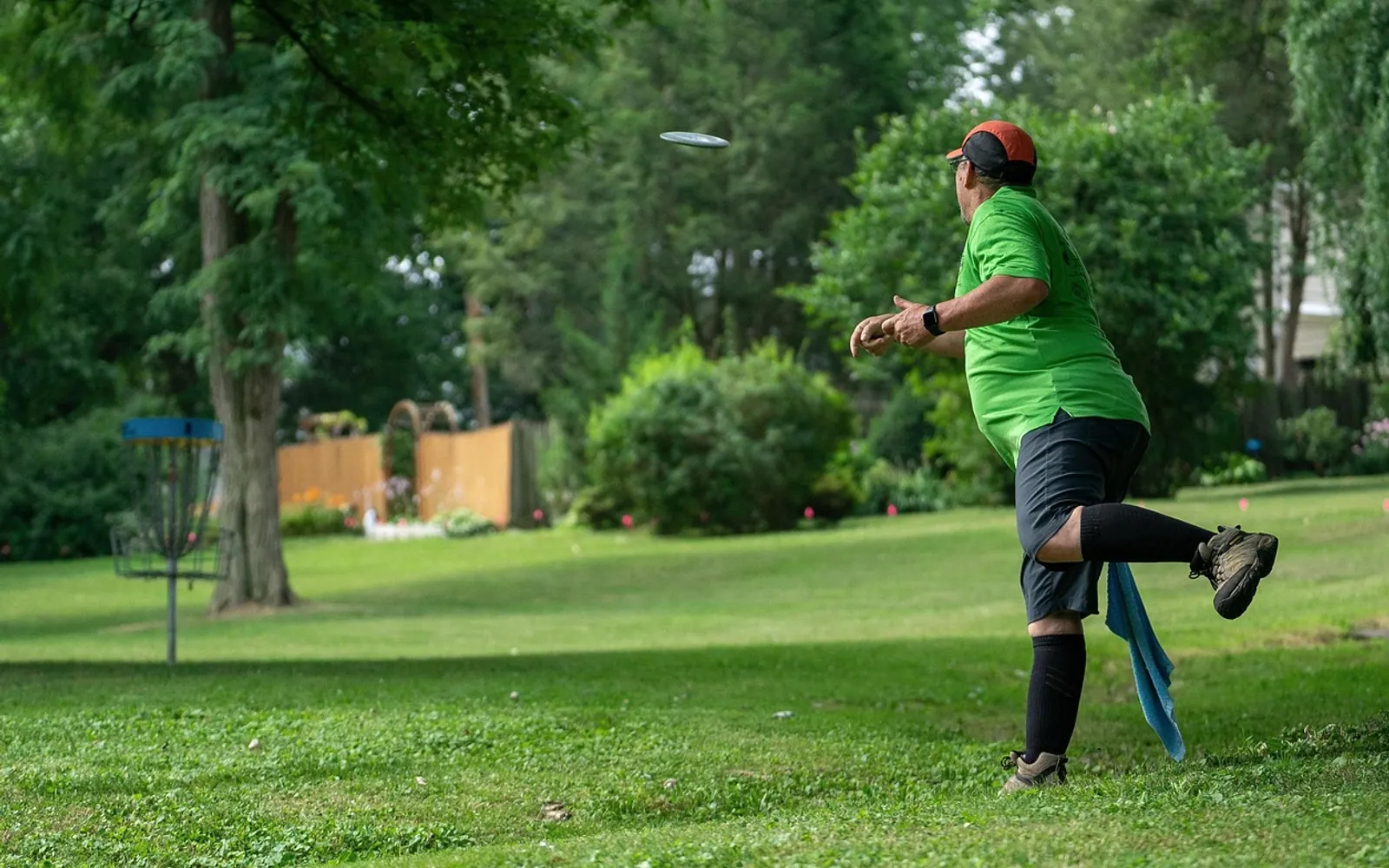
Disc golf works like ball golf with flying discs instead of clubs and balls. You throw from a tee area towards a metal basket with hanging chains, pick up the disc where it lands, throw again from that spot and keep going until the disc rests in the basket. Each throw counts as one stroke, and the player with the fewest strokes over the round wins. A couple of discs, a pair of trainers and a course nearby are all you need to start.
The basic rules
- Tee off from the tee area. Your first throw on each hole starts from the marked tee pad or zone.
- Play from your lie. The spot where your disc stops is your lie. Your next throw is made from there, with your front foot behind it.
- The farthest player throws next. After everyone has teed off, whoever is farthest from the basket goes first.
- Hole out properly. A hole is finished when the disc comes to rest in the basket or hangs in the chains. Hitting the pole alone does not count.
- Out of bounds costs a stroke. If a disc lands in an area marked out of bounds, such as water or a path, add one penalty stroke and play from where it went out, or as the course rules say.
- Order on the next tee. The player with the lowest score on the previous hole usually throws first.
Casual rounds are relaxed about the finer details. If you start playing in leagues or events, it is worth reading the official rulebook used there.
Scoring and par
Each hole has a par: the number of throws a skilled player is expected to need. Many holes are par 3, with longer or trickier ones set at par 4 or 5. Your score is written relative to par.
| Term | Meaning |
|---|---|
| Ace | Holing out with your first throw from the tee |
| Birdie | One throw under par |
| Par | Exactly the expected number of throws |
| Bogey | One throw over par |
| Double bogey | Two throws over par |
Which discs to start with
Disc golf discs are smaller, heavier and more streamlined than a beach frisbee, and they come in three main families.
Putters
Deep, blunt-edged discs that fly straight and slowly. They are made for short throws into the basket, but beginners often find them the easiest disc to throw well from anywhere.
Mid-range discs
A step up in speed with a slightly sharper edge. Good for approach shots and controlled throws from the tee on shorter holes.
Drivers
Sharp-edged discs built for distance. Fast drivers need a lot of arm speed to fly as intended; thrown too slowly, they tend to curve away early. Many coaches suggest new players start with a putter and a mid-range disc, then add a slower fairway driver once their throws feel consistent.
The two main throws
Backhand
The most common throw. Stand side-on to the target, reach the disc back across your body, then pull it through in a straight line close to your chest and release with a snap of the wrist. Keep the disc flat at release and let your hips turn with the throw.
Forehand (sidearm)
Thrown from the side like skimming a stone, with two fingers against the inside rim. It curves the opposite way to a backhand, which makes it handy for getting around trees on the other side of the fairway.
Putting
Most strokes are won or lost close to the basket. Face the target, bend your knees slightly, look at a single chain link and push the disc towards it with a smooth, short motion. On close putts, the rules usually expect you to keep your balance behind your marker after letting go, rather than stepping or falling forward. Practising at a basket for a few minutes before a round is the quickest way to save strokes.
Course etiquette for beginners
- Wait until the fairway is clear of walkers, dogs and the group ahead before you throw.
- Shout "fore" loudly if a disc is heading towards anyone.
- Stay quiet and still while someone else is throwing, and stand behind them.
- Let faster groups play through.
- Do not damage trees or plants, and take your rubbish with you.
- Write your name and phone number on each disc so a finder can return it.
Many courses sit in public parks shared with other visitors, so friendly behaviour keeps the game welcome there.
Common beginner mistakes
- Throwing for distance before accuracy. A controlled throw that lands near the fairway beats a long one into the trees.
- Using a fast driver too early.
- Rushing the putt after a good approach.
- Not looking at the hole map on the tee sign, which often shows the basket position and out-of-bounds areas.
Questions before your first round
Do I need to book?
Many park courses can be played without booking, while private or pay-to-play courses may have their own rules. Check the course's own information before you go.
How long does a round take?
It depends on the number of holes, the size of your group and how busy the course is. A small group on a quiet course moves along briskly.
What else is good for a social, low-cost sport?
Racket fans might like our guide to padel rules and scoring. If you prefer something with more adrenaline, read about a first indoor skydiving session, or how skydivers choose their kit in our article on skydiving helmets.
Hand-picked reads
 BusinessSmart, Clean, and Ready: How Container Service in Germany Keeps Cities Moving2 min
 HealthWatching TV Before Bed: Is It Really Bad for Sleep?4 min
 StreamingHow IPTV Makes Multilingual Entertainment Easier in Switzerland2 min
 BeautyThe Rise of Refillable Vapes: A Smarter Choice for Modern Vapers3 min